

Summer 2025
September 4, 2025Summer 2025
September 4, 2025Newsletters
Winter 2026

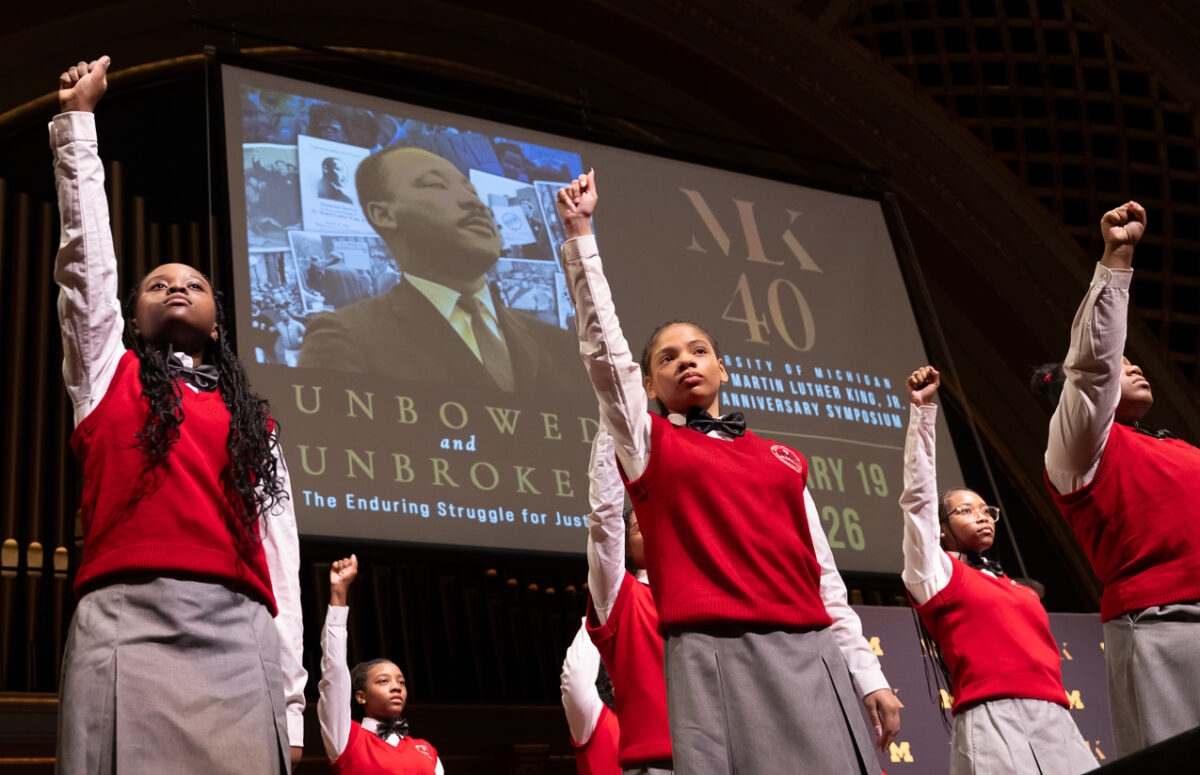
Singers from the Detroit Youth Choir perform 'Glory' during the 40th annual MLK Symposium Keynote Lecture
OAMI and U-M celebrate 40 years of the MLK Symposium
Addressing the students attending the Rev. Dr. Martin Luther King Jr. Keynote Memorial Lecture on January 19, Donzaleigh Abernathy emphasized the daunting challenges but the profound opportunities that lie ahead. “We are at a bit of a crossroads in America, unfortunately, today,” she said. “However, you all are the youth, and you have the ability to shape and create the world in which you want to live in.” The godchild of Dr. King, civil rights activist, and award-winning actress and writer, Ms. Abernathy, joined Derrick Johnson, 19th President and CEO of the NAACP, at Hill Auditorium to reflect on how the sacrifices of those who came before compel us to work toward a more equitable future.
The 2026 symposium theme, “Unbowed and Unbroken: The Enduring Struggle for Justice,” not only harkened back to the Civil Rights movement and King’s journey, but on the 40th anniversary of the symposium, it provided the framework for honoring the student activism that led to the university’s annual celebration. Four decades ago, when MLK’s birthday became a federal holiday, students took action, demanding that the University cancel classes and encourage reflection and connection. Their commitment and sacrifice not only led to the yearly cancellation of classes on the third Monday of each January but ultimately to the creation of OAMI.
The MLK Student Engagement Luncheon
With students always at the forefront of the office, OAMI works with the MLK Symposium Planning Committee to host a student luncheon after the keynote. This special event gives over 90 students an opportunity to connect with the keynote speakers in a more intimate setting. One of the key planners of the luncheon, Joseph Ballard II, director of student access, opportunity, and success at Michigan Engineering, explained that the event is “specifically designed to empower our students who are already doing the heavy lifting of leadership on campus, offering them a rare chance to seek mentorship from icons of the movement.”
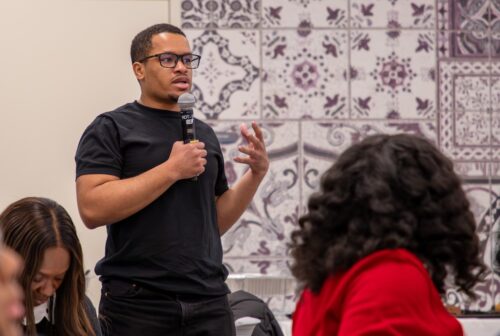
Travis Cunningham, student leader and OAMI success coach, asks a question during the MLK Student Engagement Luncheon
The luncheon is the kind of program that student activists demanded over 40 years ago: one in which the university is more than just lectures and extracurriculars, but a living laboratory for social impact. As Ballard II explained, the luncheon “transforms the symposium from a commemorative event into a tactical and intentional experience,” providing these student leaders the tools and support to confront social issues and personal challenges so that they can continue the work of Dr. King and other visionaries.
Travis Cunningham, a fifth-year and graduating senior and Academic Success Partner in SuccessConnects, said that "these types of events are pivotal because they create opportunities for mutual learning: where youth learn from elders and elders, in turn, gain insight from the younger generation. By fostering the exchange of wisdom and knowledge, these events help better equip me to navigate the obstacles in the world.”
For 40 years, the University has hosted the MLK Symposium, providing a unique opportunity for the campus community to come together and develop strategies to address our institutional and societal challenges. OAMI is honored to continue this legacy, recognizing the immense sacrifices of past generations of students and helping prepare this generation to fight for a more equitable future.
A Day On, Not a Day Off video
MLK Symposium Planning Committee members reflect on the powerful legacy of student activism at the University of Michigan and the enduring impact of the MLK Symposium. Over more than four decades, the movement for social justice has been shaped by those willing to put their education on the line and demand meaningful change.

Victors' Leadership Academy: OAMI’s latest program helps students connect the dots across campus to help ensure success
Nicholas Velasquez is part of the pilot cohort of sophomore students taking part in the Victors' Leadership Academy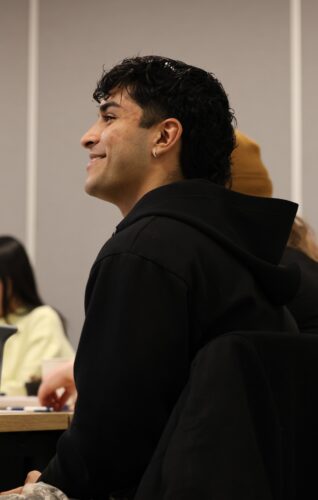
VLA directly aligns with U-M’s ongoing commitment to academic excellence, access, and student belonging. Under the leadership of Vice Provost Angela Dillard, the pilot addresses the persistent challenge of “siloed” services by building an interconnected student success ecosystem. Through intentional collaboration, VLA ensures that students don’t just access resources; they actively integrate them in their personal and professional journeys.
The VLA’s shared curriculum operates under SuccessConnects, one of OAMI’s flagship programs that has demonstrated continuous growth since its launch in 2017. Individualized development plans, academic coaching, hands-on workshops, and structured reflections are just a few of the activities and resources that broaden students' horizons, while direct access to partner offices helps break down institutional barriers to maximize impact. Ultimately, VLA aims to pave the way for a scalable blueprint that shapes how U-M supports student success university-wide.
OAMI’s interim co-director, Hector Galvan, shared how the VLA “felt like a natural extension of the work we’ve been building in OAMI. At its core, VLA is about being more intentional in how we show up for students. Too often, support exists but lives in different places, leaving students to figure it out on their own. VLA is our way of bringing that together, connecting resources, building relationships, and creating a space where students feel supported not just academically, but as whole people. He added, “When students feel that kind of support and belonging, everything else starts to open up for them.”

Post-grad mentors hone their professional skills while supporting students on their academic journey
SuccessConnects is designed to support undergraduates throughout their academic journey. One key aspect of the program is offering second-year and above students the opportunity to work with a peer mentor. For third and fourth-year students, who are already thinking about how to prepare for the transition beyond undergrad, they’re paired with a Graduate Success Partner (GSP), an active student pursuing a post-grad degree.
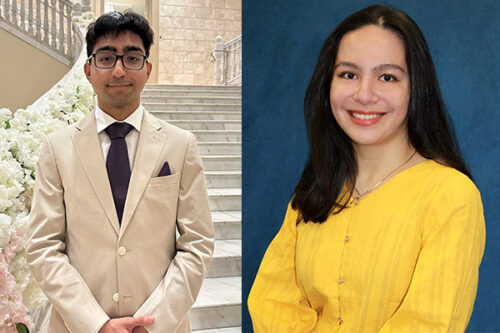
Medical student Zaid Siddiqui and law student Celina Boey are two of SuccessConnects post-grad mentors who offer tailored workshops for undergrad students
SuccessConnects students often remark on how much confidence and direction they gain from working with a GSP. Zaid Siddiqui, a medical student, says these relationships are so beneficial because GSPs like him have recently navigated the undergraduate experience in their respective fields. He and his cohort “are directly up to date on how the system works and can offer lived experience in how to navigate it.” He adds that as current post-grad students, “we are actively a part of and contributing to the field…we may know how the field is changing, connect students to opportunities and mentors directly, and give students an idea of what to expect.”
In addition to one-on-one coaching, each GSP designs and facilitates a workshop on an area of their expertise. Not only does this give SuccessConnects participants new tools and perspectives, but it also offers the GSPs additional skill-building opportunities. Celina Boey, a law student, ran a workshop on the LSAT and the law school admissions process, and said the experience provided numerous benefits for her professional development. She expressed that “it's not only a good analytical challenge in organizing thoughts and information into a useful medium, but also in how to balance reading a room and still communicating these lessons in a somewhat individualized way.” Her workshop included having participants work through LSAT example questions, which she guided them through as a group. By drawing on her own experience with the test and admissions, she was able to share tangible takeaways informed by her own challenges and breakthroughs.
One of the most common reasons GSPs take on the role is because of the mentors who helped them get to where they are today. From their own experiences, they see the impact one person can have on another, and they want to be on both the giving and receiving sides of these connections. Zaid understands the impact he can have, saying, “My primary goal is to help support my students however they can be best supported, trying to meet them where they’re at and help build skills that will be beneficial far beyond their enrollment in SC.” At the same time, these GSPs are building skills easily transferable to their own professional aspirations. So, whether in the ER or the courtroom (or anywhere else they may end up), they have the confidence to make an outsized impact in their field, and perhaps on another, less experienced colleague seeking some guidance.

Yacine Lo builds on the legacy of the Black Student Union and pays tribute to its impact during the MLK Symposium
Addressing thousands of attendees online and at Hill Auditorium, Yacine Lo embodied the enduring struggle for justice at Michigan. She declared: “I stand here before you to honor the legacy of the symposium that was brought about by the Black Action Movement III, 40 years ago, pioneered by the students of the Black Student Union. As we enjoy the symposium today, I want to remind everyone that this work continues on, with student activists fighting every day against injustice here at U-M and across the globe.”
As the current Speaker of the Black Student Union (BSU), Yacine says she sees the org as a “cultivator of community.” As their mission states, they work to promote and sustain an atmosphere that is conducive to the political, cultural, social, spiritual, economic, and educational growth of students of African descent and the University community at-large. Carrying on a tradition started in 1968, she credits the org’s success to the the hardwork and dedication of the Executive Six and her Committee Chairs, whose work is, “truly what allows this organization to work as a well-oiled machine.”
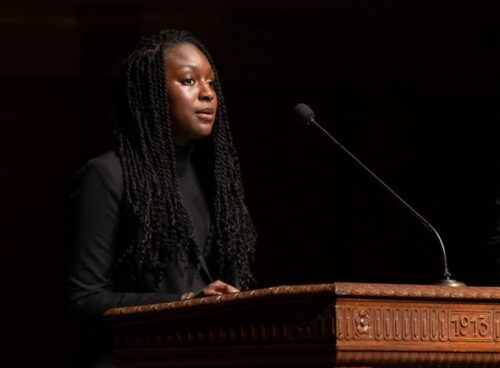
Yacine Lo recognizes the work of the Black Student Union and introduces the keynote speakers during the MLK Symposium Keynote Memorial Lecture
Recognizing the BSU's role in driving positive change for generations of students, OAMI invited Yacine to serve as the keynote lecture’s student speaker. She sees the experience as one of the most significant events of her time at Michigan, saying that it was “an amazing opportunity being able to highlight the living history and legacy of BAM III,” and she is proud that BSU played a large part in the University's creation of both the symposium and OAMI. She also understands how OAMI has been able to give back to students similar to those who made the office possible, saying that “its critical to have units like OAMI on campus that are dedicated to the academic prosperity of all students, especially BIPOC ones. Often, a lot of Black students need support in adjusting to the University, and departments such as OAMI do a great job in facilitating this transition.”
In addition to all the work Yacine does for her student community, she is pursuing a dual degree in Public Sciences and Biomolecular Science. Her plans after graduation are to earn a Master’s degree and eventually attend medical school. She says she wants to combine her passions for community health and medicine into the field of emergency medicine. This work will further her passion for supporting the broad networks around her, drawing on the strength and leadership skills she is gaining here at Michigan.